NASA's Hubble Finds Most Oxygen Missing From Nearby Dwarf Galaxies
NASA's Hubble Space Telescope has found a mystery hiding in our cosmic neighbourhood: in 37 nearby dwarf galaxies, most of the oxygen their stars ever made is missing. The finding, published on 2 November 2026 in The Astrophysical Journal, suggests that violent winds from massive stars and supernova explosions are stripping small galaxies of the chemical elements they need to build new stars and planets — far more efficiently than current models predicted.
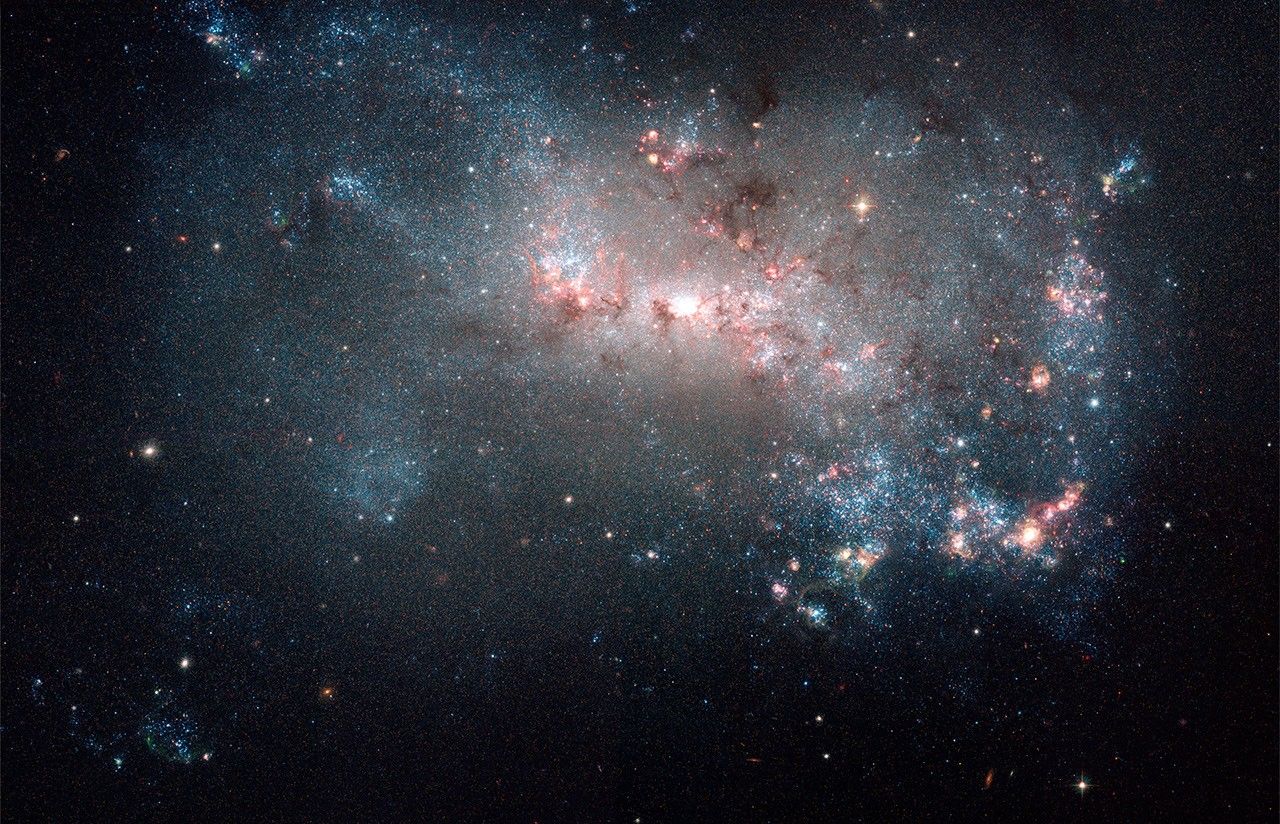
Image: NASA, ESA, Hubble Heritage–ESA/Hubble Collaboration, Alessandra Aloisi (STScI, ESA)
What happened
Dwarf galaxies are small systems containing anywhere from a few thousand to a few hundred million stars — tiny compared with the Milky Way's hundreds of billions. A team of astronomers studied 37 of these nearby galaxies as part of the Galaxies Losing Oxygen via Winds (GLOW) project, funded by NASA and the National Science Foundation, and compared what they found with computer simulations of how galaxies should behave.
The simulations said these galaxies should hold far more oxygen than they do. Instead, the researchers found that dwarf galaxies keep only a small fraction of the oxygen their stars produced. The rest appears to have been driven out into the space between galaxies. One of the galaxies in the study, NGC 4449 — a clumpy, irregular dwarf shown in Hubble's new image — is a striking example of the kind of small, star-forming system that is losing its oxygen.
How scientists know
Oxygen is a useful clue because it is the most abundant element in the universe after hydrogen and helium, it is relatively easy to detect, and astronomers understand well how stars produce it. That makes it a reliable tracer for the wider set of heavy elements inside a galaxy.
The team combined archival optical images from Hubble, which can pick out individual stars in these nearby galaxies and reveal their ages and compositions, with data from NASA's retired Spitzer Space Telescope and two ground-based radio observatories, the Very Large Array and the Australian Telescope Compact Array. Together, the data let the researchers trace oxygen atoms across the stars, gas and dust of all 37 galaxies.
The evidence points to galactic winds. Massive stars and supernova explosions release enormous energy, and in a small galaxy with weak gravity, that energy is enough to push gas — and the oxygen in it — out of the galaxy entirely.
"Oxygen is produced by stars, which are inside of galaxies. We know that the oxygen had to be inside of the galaxies at some point in the past, so the oxygen must have been ejected," said co-investigator Grace Telford, an assistant professor of physics and astronomy at the University of Utah. "And to do that, you need energy from massive stars and supernova explosions to drive material out of the host galaxies and into the space between galaxies."
Why it matters
Oxygen is one of the main elements stars forge, and tracking where it ends up tells astronomers how galaxies grow, change and enrich the space around them — the intergalactic medium from which future generations of stars and planets will form. If small galaxies are losing their heavy elements faster than models assume, those models need correcting, and our picture of how the early universe built up its chemistry shifts with them.
Astronomers already knew that larger, Milky Way-like galaxies lose a large share of their oxygen — a 2014 study found much of it in the diffuse halo of gas surrounding those galaxies. The open question now is where the dwarf galaxies' missing oxygen has gone: whether it lingers in a similar halo or has been blasted clear out of the galaxies' surroundings altogether.
The search will continue. Study leader Kristen Wingfield McQuinn, principal investigator of the GLOW project, has an approved programme to use NASA's newly launched Nancy Grace Roman Space Telescope to find even fainter, lower-mass galaxies across a wide sweep of sky, and then to follow up with Hubble and the James Webb Space Telescope to reconstruct how those tiny systems formed stars across cosmic time. Hubble, in service for more than three decades, keeps adding to that story.
Source: NASA, "NASA's Hubble Uncovers Case of Missing Oxygen in Nearby Dwarf Galaxies", published 2 November 2026.
Post a comment